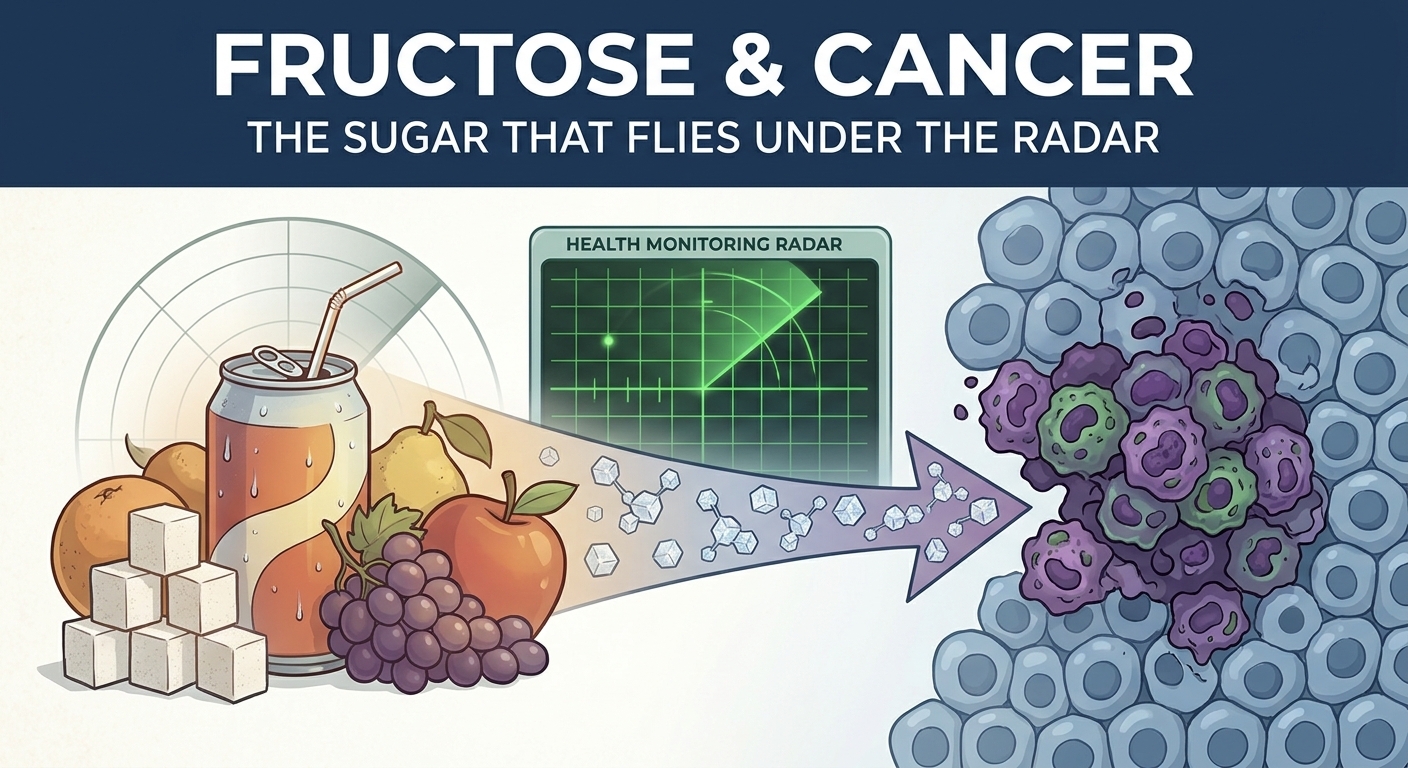
We all hear that sugar feeds cancer. And by sugar, we usually mean glucose.
But sugar has another molecule — fructose — that can be equally, and in many ways more, dangerous than glucose for cancer patients. And almost no one is talking about it.
Why Fructose Is Different From Glucose
Glucose gets all the attention in cancer metabolism, and for good reason. The Warburg effect, PET scans, insulin signaling — everything starts with glucose.
But fructose flies completely under the radar. Here is why it matters:
- It is metabolized differently than glucose — primarily in the liver, not throughout the body
- It bypasses normal insulin regulation — meaning it does not trigger the same hormonal signals glucose does
- It goes straight to the liver, where it is rapidly converted into fat, uric acid, and metabolic byproducts that fuel cancer
- Cancer cells have their own dedicated fructose transporter — GLUT5 — to pull fructose in directly, independent of glucose pathways
When glucose is restricted (through keto, fasting, or metformin) but fructose is still being consumed, many cancer cells quietly switch over and keep growing. You can be in deep ketosis and still be feeding your tumor.
Here is exactly what the published research shows fructose does once it is inside cancer cells.
How Fructose Feeds and Accelerates Cancer
1. It Fuels Cancer Cell Proliferation Directly
A landmark UCLA study demonstrated that pancreatic cancer cells use fructose to activate the pentose phosphate pathway through an enzyme called transketolase. This pathway produces the building blocks for new DNA and RNA.
In other words, fructose does not just feed cancer. It gives cancer the raw materials to replicate itself.
The UCLA researchers directly stated that their findings have “major significance for cancer patients given dietary refined fructose consumption” — and their data showed fructose was used by cancer cells differently and sometimes more effectively than glucose for building new cells.
📄 Liu H et al. Fructose induces transketolase flux to promote pancreatic cancer growth. Cancer Research, 2010. 🔗 https://pubmed.ncbi.nlm.nih.gov/20647326/
2. It Drives Treatment Resistance
Fructose induces metabolic reprogramming in cancer cells — making them more aggressive, more adaptable, and more resistant to chemotherapy and targeted therapies.
Cancer cells exposed to fructose:
- Upregulate GLUT5 expression (more fructose entry, more fuel)
- Shift toward anabolic metabolism (building more biomass)
- Activate stress-response pathways that protect them from cytotoxic drugs
- Develop cross-resistance to multiple chemotherapy agents
A patient fighting cancer while consuming fructose is essentially training their tumor to survive better.
3. It Fuels Metastasis
Ovarian cancer cells specifically use fructose through the GLUT5–KHK axis (KHK is ketohexokinase, the first enzyme in fructose metabolism) to drive proliferation and spread to distant organs.
Fructose supports metastasis through several mechanisms:
- Provides energy for circulating tumor cells
- Supplies lipids for building new cell membranes at distant sites
- Supports the rapid cell division needed to establish new metastatic colonies
- Weakens immune cells in distant tissues
📄 Jin C et al. Fructose induced endothelial dysfunction and GLUT5 overexpression in cancer. Multiple studies 2018-2024. 🔗 https://pubmed.ncbi.nlm.nih.gov/30543830/
4. It Drives Chronic Inflammation
Fructose metabolism produces uric acid as a byproduct. Uric acid is not just a cause of gout — it is a powerful activator of NF-κB, the master switch of cancer-related inflammation.
The consequences:
- Chronic low-grade systemic inflammation
- Elevated IL-6, TNF-α, and other tumor-promoting cytokines
- Suppression of the immune cells that would otherwise attack cancer
- Damage to the gut lining and leaky gut syndrome
- Fatty liver (NAFLD) — which further weakens cancer defense
Chronic inflammation is one of the strongest drivers of tumor initiation, progression, and immune evasion. Fructose fuels it constantly.
5. It Bypasses Every Metabolic Safeguard
This may be the most dangerous property of fructose.
Unlike glucose, fructose bypasses the phosphofructokinase (PFK) checkpoint — the regulatory enzyme in glycolysis that normally decides how much sugar actually enters the energy-production pathway.
PFK is the body’s metabolic traffic light. When energy is abundant, PFK slows down and limits glucose entry into the cell’s metabolic engine.
Fructose has no such brake. It enters glycolysis unregulated, floods cancer cells with metabolic intermediates (triose phosphates, acetyl-CoA, lactate), and provides everything the tumor needs to grow — regardless of the cell’s actual energy state.
This is why fructose produces so much liver fat so quickly. And this is why it is so dangerous for cancer patients: it is metabolic fuel with no governor.
Where Fructose Is Hidden
This is where most patients get caught. Fructose is not just in candy and soda. It is in many foods people think are healthy:
High-fructose sources:
- High-fructose corn syrup (HFCS) — in nearly all processed food, sauces, dressings, breads, and beverages
- Table sugar (sucrose) — 50% fructose by weight
- Agave syrup — up to 90% fructose, worse than HFCS
- Honey — 40–50% fructose
- Maple syrup — about 35% fructose
- Fruit juices — concentrated fructose without the fiber
- Dried fruits — dates, raisins, figs, prunes — dramatically concentrated fructose
- Smoothies — especially “healthy” ones with multiple fruits
- Most fruits — apples, pears, grapes, mangoes, bananas (varying levels)
- “Natural” sweeteners — coconut sugar, date syrup, molasses
Lower-fructose foods (keto-compatible in modest amounts):
- Berries — blueberry, raspberry, blackberry, strawberry (still contain some fructose, use in small portions)
- Avocado
- Olives
- Lemons and limes
- Green leafy vegetables
- Cruciferous vegetables (broccoli, cauliflower, cabbage)
The common mistake is replacing table sugar with “natural” alternatives like honey or agave — thinking they are safer. For cancer patients, they are often worse.
What You Need to Do
The approach is clear and non-negotiable for serious cancer protocols:
- Eliminate all high-fructose sources — HFCS, table sugar, agave, honey (yes, including raw honey), maple syrup, fruit juice, dried fruits, most fruits
- Follow a strict ketogenic protocol — under 20 g total carbohydrates daily, with fructose-containing foods minimized or eliminated
- Read every label — processed food is saturated with hidden HFCS even in savory items (bread, dressings, deli meats, sauces)
- Avoid “healthy sweeteners” — agave and honey are not health foods for cancer patients
- Use safer alternatives when sweetness is needed — stevia, erythritol, monk fruit, allulose (these do not feed cancer)
- Monitor uric acid on blood panels — elevated uric acid often signals fructose overload
- Support the liver — milk thistle and TUDCA are especially important given that fructose metabolism burdens the liver
If you have been in “ketosis” but still consuming fruit, honey, or “natural sweeteners,” you have not been following a cancer-therapeutic ketogenic diet. You have been feeding your tumor through the back door.
The Bottom Line
Fructose is hidden everywhere — fruits, juices, processed food, high-fructose corn syrup, honey, agave, dried fruits, and even “healthy” smoothies.
The science is published and clear. Fructose:
- Fuels cancer cell proliferation and provides the raw materials for DNA replication
- Drives chemotherapy resistance and metabolic reprogramming
- Promotes metastasis through the GLUT5–KHK axis
- Feeds chronic inflammation through uric acid and NF-κB
- Bypasses every metabolic safeguard your body has
This is exactly why strict ketogenic nutrition with zero fructose is a cornerstone of the Targeted Metabolic Therapy protocol. The goal is to limit every major fuel source cancer depends on — not just glucose, but fructose and glutamine as well.
Cutting glucose alone and ignoring fructose is like closing the front door while leaving the back door wide open. The cancer walks right through it.
Dr. Yahia Anane, PhD — drananeyahia.com

