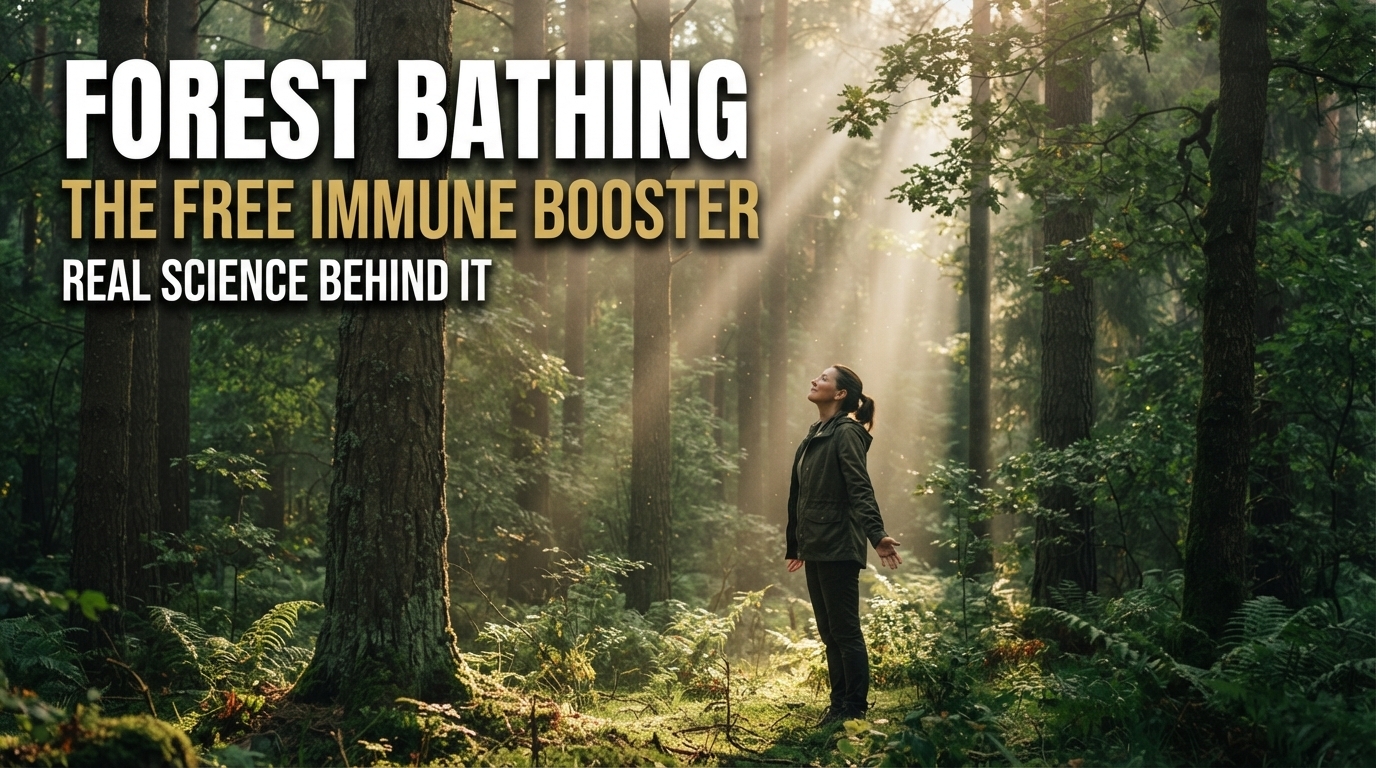
Forest bathing is one of the most powerful things a cancer patient can do to strengthen the immune system.
It costs nothing. It requires no equipment. And the science behind it is real, measurable, and reproducible.
Here is what it does — and how to actually use it.
What Is Forest Bathing?
Shinrin-yoku is the Japanese term for forest bathing. Translated literally, it means “taking in the forest atmosphere.”
It is not hiking. It is not exercise. It is simply being present in a forest — walking slowly, breathing deeply, and letting your senses take in the environment. No headphones. No phone. No goal. Just presence.
In Japan, forest bathing is officially recognized as a preventive medicine practice. Certified therapeutic forests exist across the country, and doctors prescribe forest visits the way Western doctors prescribe supplements.
The reason is simple: the biology is real.
The Mechanism
Trees release airborne compounds called phytoncides — natural antimicrobial oils they produce to defend themselves against bacteria, fungi, and insects. The most abundant include alpha-pinene, beta-pinene, limonene, and d-limonene.
When you breathe these compounds in, something remarkable happens inside your body.
Your Natural Killer (NK) cells — the immune system’s direct weapon against cancer — increase in both number and activity.
NK cells are one of the few immune cells that can detect and kill cancer cells without prior exposure. They do this by releasing three anti-cancer proteins directly into tumor cells:
- Perforin — punches holes in the cancer cell membrane
- Granzymes — enter through those holes and trigger the cancer cell’s self-destruct program
- Granulysin — disrupts the cancer cell membrane and triggers apoptosis
Forest air measurably elevates all three of these proteins.
This is not metaphor. It is not “nature is calming.” It is measurable, blood-testable, quantifiable immunology.
The Science
Dr. Qing Li at Nippon Medical School in Tokyo is the world’s leading researcher on forest bathing biology. His work has established the effect through multiple controlled studies.
In one landmark study, 11 out of 12 subjects showed approximately 50% higher NK cell activity after just a 3-day forest trip — with significantly increased levels of perforin, granzymes, and granulysin.
When the same subjects were sent on a city trip instead, the changes were zero. No increase in NK activity. No change in anti-cancer proteins. The effect was specific to forest exposure.
The effects were also long-lasting:
- Elevated NK activity persisted for more than 7 days after a single forest trip
- Some subjects still showed elevated NK activity 30 days later
Subsequent studies confirmed the same effects in women with breast cancer specifically — a population where NK cell function is often suppressed and directly correlates with survival.
📄 Li Q. Effect of forest bathing trips on human immune function. Environmental Health and Preventive Medicine, 2010. 🔗 https://pubmed.ncbi.nlm.nih.gov/19568835/
Why This Matters for Cancer Patients
NK cells are one of the most important defenses against:
- Circulating tumor cells — the ones responsible for metastasis
- Early tumor formation — before it becomes clinically detectable
- Cancer recurrence — after treatment
Chemotherapy, chronic stress, poor sleep, and systemic inflammation all suppress NK cell function. For most cancer patients, NK activity is already below optimal — and the tools to restore it are limited.
Forest bathing is one of the few interventions that:
- Directly and measurably increases NK number and activity
- Has effects that last for weeks after a single session
- Costs nothing
- Has no side effects
- Requires no medical clearance
This is exactly the kind of intervention that should be built into every cancer patient’s routine.
How to Actually Do It
Forest bathing is simple, but there is a right way to do it. Following the actual protocol is what produces the immune response.
The basics
- Location: a real forest, or at least a dense wooded area. Not a park with a few trees. The higher the tree density, the higher the phytoncide concentration in the air.
- Duration: 2 to 4 hours per session for full benefit. Even a 30-minute session produces measurable effects.
- Frequency: ideally 2 to 4 hours per week, or a 2 to 3-day immersion once per month if possible.
The practice
- Walk slowly. Not exercise pace. Slow enough to notice things around you.
- Breathe deeply through your nose. This maximizes phytoncide inhalation. Diaphragmatic breathing amplifies the effect.
- Stay off electronic devices. No phone, no earbuds, no calls.
- Engage all five senses. Look, listen, smell, touch, feel the temperature and humidity.
- Sit and rest periodically. Not everything needs to be moving.
- Stay for the season it is. Different trees, weather conditions, and seasons produce different phytoncide profiles.
When phytoncide concentration is highest
- Coniferous forests (pine, cedar, cypress, fir) produce the highest phytoncide levels
- Morning hours typically have higher phytoncide concentrations than midday
- Warm, humid days amplify airborne phytoncide levels
- After rain — phytoncide release peaks as trees respond to the moisture
If you cannot get to a forest regularly, consider:
- Essential oils from coniferous trees — pine, cedarwood, cypress. Diffuse them at home to partially replicate the phytoncide exposure. Not as powerful as a real forest, but better than nothing.
- Houseplants — dense, live indoor plants produce some phytoncide effect over time.
- A weekend forest trip once a month — enough to sustain NK activity elevation between sessions.
The Bottom Line
Trees produce airborne compounds that measurably activate your Natural Killer cells — the immune system’s direct weapon against cancer.
- One weekend in a forest can elevate NK activity for up to a month
- Three anti-cancer proteins — perforin, granzymes, granulysin — all increase measurably
- Effects were confirmed in breast cancer patients specifically
- Free, accessible, no side effects, no medical clearance required
For cancer patients, this is one of the highest-return, lowest-cost interventions available. It requires no supplements, no drugs, no equipment. Just time in the right environment.
Go outside. Find a real forest. Walk slowly. Breathe deeply through your nose. Stay long enough for your body to respond.
Your NK cells are listening.
Dr. Yahia Anane, PhD — drananeyahia.com

