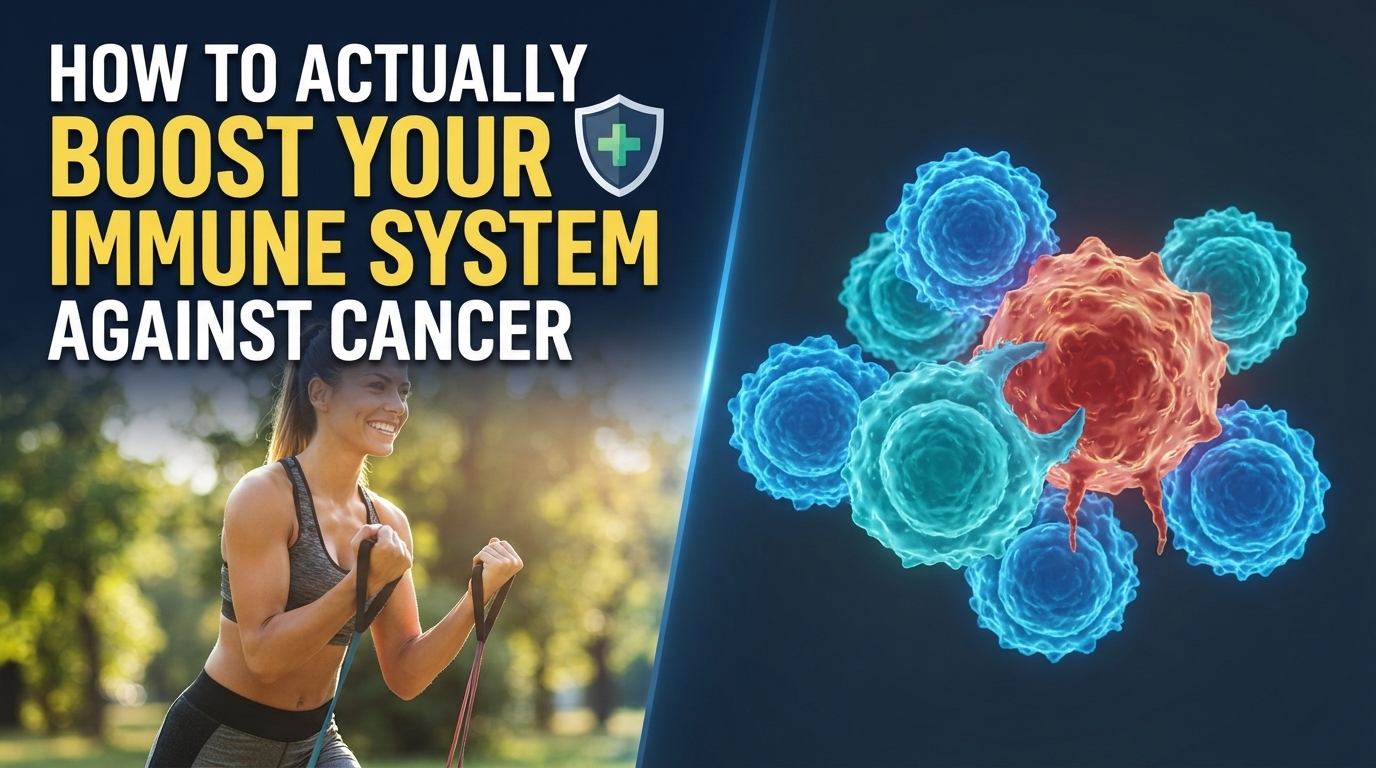
Your immune system is your only real line of defense against cancer.
It is the only system in your body that actually recognizes and kills cancer cells directly. Every other intervention — diet, drugs, supplements — either supports the immune system or targets the tumor in ways that ultimately require immune function to finish the job.
If your immune system is on the floor, no protocol will save you.
Here is the biology of how to build it back — and the simplest way to track whether it is actually working.
The Single Best Marker to Track
Forget complicated immunology panels. The simplest, cheapest, and most reliable way to track your immune strength is to look at one number on your standard complete blood count:
Your lymphocytes.
Lymphocytes are your anti-cancer soldiers — mainly T-cells (which directly kill cancer cells and coordinate immune responses) and NK cells (which detect and destroy circulating tumor cells and metastases).
- Low lymphocytes — immune suppression, higher risk of recurrence and progression
- Stable, strong lymphocytes — better immune surveillance, better outcomes
The healthy range is typically 1,500 to 4,000 cells per microliter, with 2,000 to 3,000 being ideal for a cancer patient. Below 1,000 is a serious red flag.
Also track these related ratios on your CBC:
- NLR (Neutrophil-to-Lymphocyte Ratio) — should be under 3. Higher indicates inflammation and immune dysfunction.
- LMR (Lymphocyte-to-Monocyte Ratio) — should be above 3. Lower indicates immune suppression.
- PLR (Platelet-to-Lymphocyte Ratio) — should be under 200. Higher indicates increased metastatic risk.
These three ratios are among the strongest prognostic markers in oncology, and they cost nothing extra to calculate. Track them every 4 to 8 weeks.
How to Actually Build the Immune System
1. Deep Ketosis — The Metabolic Foundation
Ketone bodies are more than just an alternative fuel. Beta-hydroxybutyrate (BHB) directly improves the metabolic fitness of your CD8+ T-cells — the specialized immune cells that kill cancer.
When T-cells are running on glucose in a tumor-dominated microenvironment, they lose the metabolic competition against cancer cells and become exhausted. When they switch to ketones, they regain their killing capacity and durability.
How to achieve it:
- Ketogenic diet — under 20 g of carbohydrates per day
- Intermittent fasting — 16:8 or 18:6
- Periodic prolonged fasting — 48 to 72 hours, cycled
- Exogenous ketones (BHB salts or esters) as an adjunct when needed
Blood ketones above 1.5 mmol/L are the threshold for meaningful immune benefit. Above 3.0 mmol/L for therapeutic-level ketosis.
2. Nutrients That Actually Matter
Immune function is nutrient-dependent. Most cancer patients are deficient in the exact nutrients their immune cells need most.
Vitamin D — activates the vitamin D receptor on T-cells and NK cells, enhances NK cytotoxic activity, and regulates the transition from inflammation to resolution.
- Target blood level: 60 to 80 ng/mL
- Typical dose: 5,000 to 10,000 IU daily with vitamin K2 (MK-7)
- Test every 3 months and adjust
Zinc — required for T-cell development, receptor signaling, and thymic function. Deficiency directly reduces lymphocyte counts.
- Typical dose: 15 to 30 mg daily with copper (1 to 2 mg) to prevent imbalance
- Take with food
Selenium — increases NK cell cytotoxic activity through glutathione peroxidase enzymes, supports T-cell proliferation.
- Typical dose: 200 mcg daily as selenomethionine
- Do not exceed 400 mcg daily long-term
Magnesium — cofactor for hundreds of enzymatic reactions, including immune cell activation.
- Typical dose: 300 to 600 mg daily as glycinate, malate, or threonate
Vitamin C — enhances lymphocyte proliferation and NK activity, and supports T-cell function.
- Typical dose: 2 to 5 grams daily in divided doses (oral). IV vitamin C at higher doses in select cases.
Vitamin A — essential for mucosal immunity and T-cell differentiation.
- Preferably from food (liver, cod liver oil, egg yolks)
3. Low-Dose Naltrexone (LDN)
LDN is one of the most powerful immune modulators in the entire repurposed drug toolbox — and one of the most overlooked.
At low doses (1.5 to 4.5 mg at bedtime), naltrexone briefly blocks opioid receptors. The body responds by increasing endogenous endorphin and met-enkephalin production. These endogenous opioids modulate:
- T-cell regulation (especially the balance of Th1 vs Th2 responses)
- NK cell activity
- Inflammatory signaling through TLR4 and NF-κB
The result: reduced inflammation, restored immune balance, and better immune surveillance of cancer cells — without immunosuppression.
LDN is especially valuable for cancer patients with autoimmune conditions, chronic inflammation, or a history of immune dysfunction. It pairs well with virtually every other component of the TMT protocol.
4. Medicinal Mushrooms
Certain mushrooms contain beta-glucans — complex polysaccharides that act as immune training signals. They interact with dendritic cells, macrophages, and NK cells through specific receptors (Dectin-1, TLR2/4, CR3), activating the innate immune system without causing inflammation.
The strongest evidence exists for:
- Turkey Tail (Trametes versicolor / Coriolus) — extensively studied in breast, gastric, and colorectal cancer. PSK and PSP extracts have randomized controlled trial data showing improved survival when added to conventional treatment.
- Reishi (Ganoderma lucidum) — modulates T-cell balance, reduces cancer-related fatigue
- Maitake (Grifola frondosa) — D-fraction extract enhances NK cell activity
- Shiitake (Lentinula edodes) — AHCC and lentinan enhance immune competence
- Cordyceps — improves mitochondrial function and exercise tolerance
Typical protocol: a multi-mushroom extract standardized for beta-glucan content, 1 to 3 grams daily with food. Look for products that verify beta-glucan concentration — many cheap mushroom products contain mostly starch (mycelium grown on grain) and negligible actual beta-glucan.
5. Exercise
Exercise is one of the most powerful immune-modulating interventions available — free, accessible, and backed by decades of research.
A single exercise session mobilizes NK cells, T-cells, and monocytes into circulation. Regular exercise:
- Increases baseline NK cell activity
- Improves T-cell function and durability
- Reduces chronic inflammation
- Enhances lymphatic drainage
- Improves mitochondrial function in immune cells
- Lowers insulin and IGF-1 — which directly benefits T-cell metabolic fitness
The right dose:
- Daily walking — 30 to 60 minutes, ideally outdoors and in natural light
- Resistance training — 2 to 3 times per week, focused on major muscle groups
- Rebounding — 10 to 20 minutes daily, for lymphatic and immune circulation
- Zone 2 cardio — 2 to 3 sessions per week
- Short high-intensity intervals — once or twice weekly, if tolerated
Do not exhaust yourself. Extreme endurance exercise actually suppresses immunity temporarily. Moderate, consistent movement is the sweet spot for cancer patients.
Additional Immune-Building Tools
Beyond the five above, several other interventions deserve mention:
- Forest bathing — measurable NK cell increases lasting up to 30 days after a single trip
- Lactoferrin — restricts iron from cancer cells, boosts NK and macrophage activity
- Curcumin — modulates T-cell regulation, reduces immunosuppressive cytokines
- Quercetin — clears senescent cells, supports NK function
- Sleep optimization — melatonin is one of the most powerful immune-supporting hormones. Poor sleep collapses T-cell and NK activity within days.
- Stress management — chronic cortisol elevation directly suppresses lymphocyte function
- Gut health — 70% of your immune system lives in the gut. Probiotics, fermented foods, and gut barrier support (L-glutamine) are essential.
What Suppresses Immunity — And Must Be Removed
You cannot build an immune system while actively destroying it. The following must be reduced or eliminated:
- Chronic high blood sugar and insulin — directly suppresses lymphocyte function
- Ultra-processed food and seed oils — drive inflammation and immune dysfunction
- Poor sleep — reduces NK activity within 24 hours
- Chronic stress and cortisol elevation — suppresses T-cells and NK cells
- Alcohol — impairs immune cell function measurably
- Environmental toxins — pesticides, plastics, heavy metals, mold exposure
- Nutrient deficiencies — most common: vitamin D, magnesium, zinc, B12
- Unnecessary antibiotics — destroy the gut microbiome that supports 70% of immunity
Removing these obstacles matters as much as adding new interventions.
The Bottom Line
Cancer progresses when the immune system fails. Every other intervention in your protocol depends on immune function to finish the job.
- Track your lymphocytes — plus NLR, LMR, and PLR every 4 to 8 weeks
- Build metabolic strength through deep ketosis
- Support with strategic nutrients — vitamin D, zinc, selenium, magnesium, vitamin C
- Add Low-Dose Naltrexone for intelligent immune modulation
- Feed the immune system training signals with medicinal mushrooms
- Move your body daily — walking, resistance training, rebounding
- Remove what suppresses immunity — sugar, seed oils, poor sleep, chronic stress, toxins
That is how you strengthen the only system in your body that actually kills cancer cells.
Everything else you do in a metabolic protocol works better when your immune system is strong. Everything else you do works less well — or fails entirely — when it is weak.
Watch the lymphocytes. Feed the soldiers. Do the work.

